




FAQ
FREQUENTLY ASKED QUESTIONS ABOUT AIR CONDITIONING, HVAC SYSTEMS AND INDOOR AIR QUALITY
How do I choose the right air conditioner for my home?
Choosing the right air conditioner depends on several factors, including the size of the area to be conditioned, the building’s insulation level, sun exposure, the number of occupants and the expected usage throughout the year.
A technical inspection allows us to identify the most suitable power rating, avoiding unnecessary consumption while ensuring maximum comfort.
What is the difference between an air conditioner and a climate control system?
The two terms are often used as synonyms. However, modern climate control systems are generally heat pumps that can both cool and heat indoor spaces, while the term “air conditioner” is still commonly used to refer to any cooling system.
Is installing a heat pump convenient?
Yes, especially in well-insulated homes or during renovation works.
Heat pumps can provide heating, cooling and domestic hot water production with lower energy consumption compared to traditional systems, helping reduce both operating costs and environmental impact.
How much energy does a modern air conditioner consume?
Consumption depends on the energy efficiency class, system power and operating time.
Latest-generation inverter air conditioners automatically adjust their output according to actual demand, reducing energy consumption compared to traditional systems.
How often should an air conditioner be maintained?
It is recommended to carry out maintenance at least once a year.
Cleaning filters and checking the system improves energy efficiency, indoor air quality and the lifespan of the equipment.
For systems containing fluorinated refrigerant gases (F-Gas), regulations may require specific checks depending on the quantity of refrigerant expressed in tonnes of CO? equivalent. Not all domestic air conditioners are subject to these requirements, but it is advisable to have your system checked by a qualified technician.
What are the advantages of a ducted air conditioning system?
A ducted system offers several benefits:
- uniform comfort throughout the building;
- greater silence compared to traditional split systems;
- no visible indoor units;
- improved aesthetic integration with interiors;
- the possibility of managing multiple rooms with a single system.
When should an old air conditioner be replaced?
If an air conditioner is more than 10-15 years old, has high energy consumption or uses outdated refrigerants, replacing it with a new high-efficiency model can be a cost-effective choice.
What is a ducted air conditioning system?
A ducted air conditioning system distributes conditioned air through hidden ducts installed in the ceiling or false ceiling, allowing multiple rooms to be conditioned using a single indoor unit.
It is an elegant, quiet and efficient solution, particularly suitable for new buildings and renovation projects.
What are the advantages of Mechanical Ventilation with Heat Recovery (MVHR)?
Mechanical Ventilation with Heat Recovery continuously renews indoor air by removing humidity, mould, odours and pollutants without the need to open windows.
Systems with heat recovery also improve the building’s energy efficiency by reducing heat losses.
Does MVHR eliminate mould?
MVHR helps reduce mould formation by controlling indoor humidity levels.
If mould problems are mainly caused by condensation, correct ventilation can significantly improve the situation.
Is a split air conditioner or a ducted system better?
Split systems are generally the simplest and most economical solution, while ducted systems provide more uniform air distribution, better aesthetics and greater silence.
The best choice depends on the building layout, technical requirements and available budget.
Is it possible to air condition an entire home with a single unit?
Yes. This can be achieved through multi-split systems or correctly designed ducted systems.
The best solution depends on the size and layout of the property.
How long does air conditioner installation take?
A standard installation usually requires one working day.
Ducted systems or more complex installations may require additional time depending on the project requirements.
Do you offer free inspections and quotations?
Yes. A technical inspection allows us to evaluate the characteristics of the building and propose the most efficient solution in terms of comfort, energy consumption and aesthetics.
Do you install air conditioning systems for homes and businesses?
Yes. We design and install systems for apartments, villas, offices, shops, commercial activities and industrial environments, providing customised solutions.
Which air conditioner brands do you recommend?
The choice depends on the customer’s specific requirements.
We generally recommend manufacturers recognised for reliability, energy efficiency, low noise levels and strong technical support networks.
Can a ducted system also heat the home?
Yes. When combined with a reversible heat pump, a ducted system can provide both summer cooling and winter heating, ensuring comfort throughout the year.
Is a ducted system suitable for apartments?
Yes, provided there is sufficient space for installing the ductwork, usually inside a false ceiling.
For this reason, ducted systems are particularly suitable for new constructions and renovation projects.
Does a ducted air conditioner consume more energy than a split system?
Not necessarily.
Energy consumption depends on the efficiency of the equipment, correct system design and usage habits.
A properly sized ducted system equipped with inverter technology can achieve very low energy consumption.
Can I set different temperatures in each room?
Yes.
By integrating a zoning control system, it is possible to set different temperatures in each room, improving comfort and reducing energy consumption.
How long does the installation of a ducted system take?
Installation times depend on the complexity of the project and the characteristics of the building.
In new constructions, installation is generally faster, while renovations may require additional work for creating the duct network.
What is the difference between ducted air conditioning and a multi-split system?
A multi-split system uses several visible indoor units, while a ducted system uses a single indoor unit connected to a hidden air distribution network.
A ducted solution provides cleaner aesthetics and more uniform air distribution.
Can a ducted system be installed in an already occupied home?
Yes, in many cases it is possible.
Feasibility depends on the building structure and the available space for installing ducts. A technical inspection allows us to identify the most suitable solution.
How often should a ducted system be cleaned?
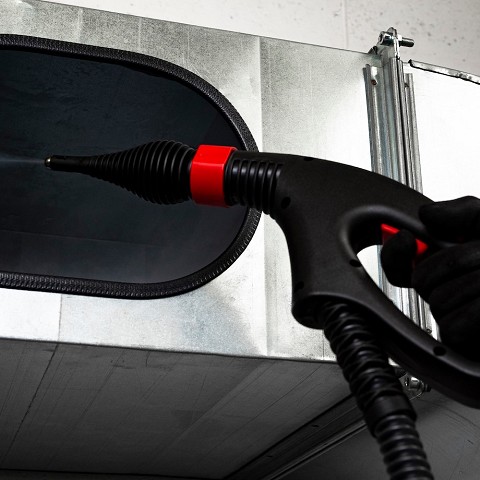
Routine maintenance should generally be carried out at least once a year and includes:
- filter cleaning;
- indoor unit sanitisation;
- system performance checks.
For intensive use or particular environments, more frequent maintenance may be recommended.
Why choose a ducted system instead of split units?
A ducted system is ideal for those who want uniform comfort, quieter rooms and a cleaner interior design without visible indoor units.
With proper zoning control, it also allows efficient temperature management in different areas.
What is Airzone and how does it work?
Airzone is an intelligent zoning control system that allows independent climate management of each room.
Through dedicated thermostats and motorised dampers installed in the ductwork, Airzone automatically regulates airflow to each area, maintaining the desired temperature and optimising system operation.
What advantages does Airzone offer compared to a traditional ducted system?
In a traditional ducted system, all rooms are usually conditioned at the same time.
With Airzone, each room can be managed independently: different temperatures can be set, and unused zones can be switched off completely.
This improves comfort, reduces energy waste and makes the system more efficient.